
This semester at Bible College, I’ve had the opportunity to study the life of Dietrich Bonhoeffer and to consider his influence on the Church during one of the darkest periods in Germany’s history. What struck me was how many of the questions confronting the Church then remain remarkably relevant today.
What do Christianity and Judaism have in common, if anything? How should the Church understand its relationship with the Israel of today? What responsibilities do Christians have towards the Jewish people? And how should our answers to these questions shape the way we engage in public discourse about contemporary political and social issues?
These are significant questions, and the answers aren’t always straightforward. They’re often complicated by theological frameworks, differing understandings of the relationship between Israel and the Church, and centuries of Christian attitudes towards Judaism. Add to this the political realities of the modern Middle East, and it becomes increasingly difficult to separate what Scripture actually teaches from the assumptions, loyalties, and historical baggage we bring to the conversation.
Yet these are questions Christians can’t afford to ignore. Our understanding of Israel isn’t merely a matter of eschatology or political allegiance. It touches on how we read Scripture, how we understand God’s faithfulness to His promises, and how we regard a people whose history is inseparable from the story of our own faith.
And, unfortunately, we also can’t ignore the centuries of anti-Jewish prejudice that continue to filter into these conversations, often putting the Jewish people at a marked disadvantage before the merits of any argument have even been considered.
Such was the case in Bonhoeffer’s Germany, and for centuries before him. The age-old distrust of Jews forms part of the historical bedrock upon which the Jewish question continues to be debated, whether concerning their ongoing place in God’s redemptive purposes or even their legitimate place on the world’s stage.
Christianity and Its Jewish Roots
Hitler wasn’t the first to suggest that something was “too Jewish.” Nearly two millennia before him, Marcion of Sinope, one of the most controversial figures in the early Church, suggested something similar.
He drew a distinction between God the Father of Jesus Christ, revealed in the New Testament, and the God of the Old Testament, the God of the Hebrews, teaching that they weren’t the same deity.
Attempting to detach Christianity from its Jewish roots, Marcion produced his own radically reduced collection of Christian writings, rejecting the Hebrew Scriptures entirely and retaining only an edited version of Luke’s Gospel and ten of Paul’s letters. These texts were presented in a form that minimised or excluded references connecting Jesus and his teachings to the God, Scriptures, and covenant promises of Israel.
In doing so, he effectively cut out the root of the Christian faith, its historical Jewish context, history, people, and story. The Church rightly recognised that Marcion’s theology undermined the continuity of God’s revelation and promise, and the connection between Israel and Christianity.
The Messiah promised in the Old Testament was the same Messiah revealed in the New Testament. Jesus himself said, “I have not come to abolish them but to fulfil them” (Matthew 5:17), speaking of the Law and the Prophets.
God’s promises made to Abraham, the father of the nation, are the same promises revealed in and which find fulfilment through Jesus in the New Testament (Galatians 3:16). The great pouring out of the Holy Spirit on the day of Pentecost was in direct fulfilment of prophetic witness. (Acts 2:16, Joel 2:28–32).
And the blessing promised to all people would come through the descendant promised to Israel’s great patriarchs of old (Genesis 12:3; see also Galatians 3:8).
One Tree, Many Branches
There’s no separating Christianity from its Jewish roots.
But that’s not to say, of course, that Judaism and Christianity are the same thing. Many Jews roundly rejected Jesus as a Messiah figure, denounced the Church as connected in any part to the ancient Jewish faith, and even Rome itself began to make the distinction between the two, recognising them as separate religious communities rather than simply different expressions of Judaism.
Yet the truth remains. Christianity didn’t emerge independently of Judaism. Jesus was Jewish, his apostles were Jewish, the earliest believers were Jewish, and the Scriptures upon which the Christian faith was founded were the sacred writings of Israel.
Whatever distinctions eventually developed between the two faiths, Christianity couldn’t simply erase its Jewish origins without also undermining its own theological foundations.
Has The Church Replaced Israel?
Okay, well and good. But hasn’t God transferred his promises and covenants to the Church? Isn’t Israel today no more significant in God’s plans or in his heart than any other nation?
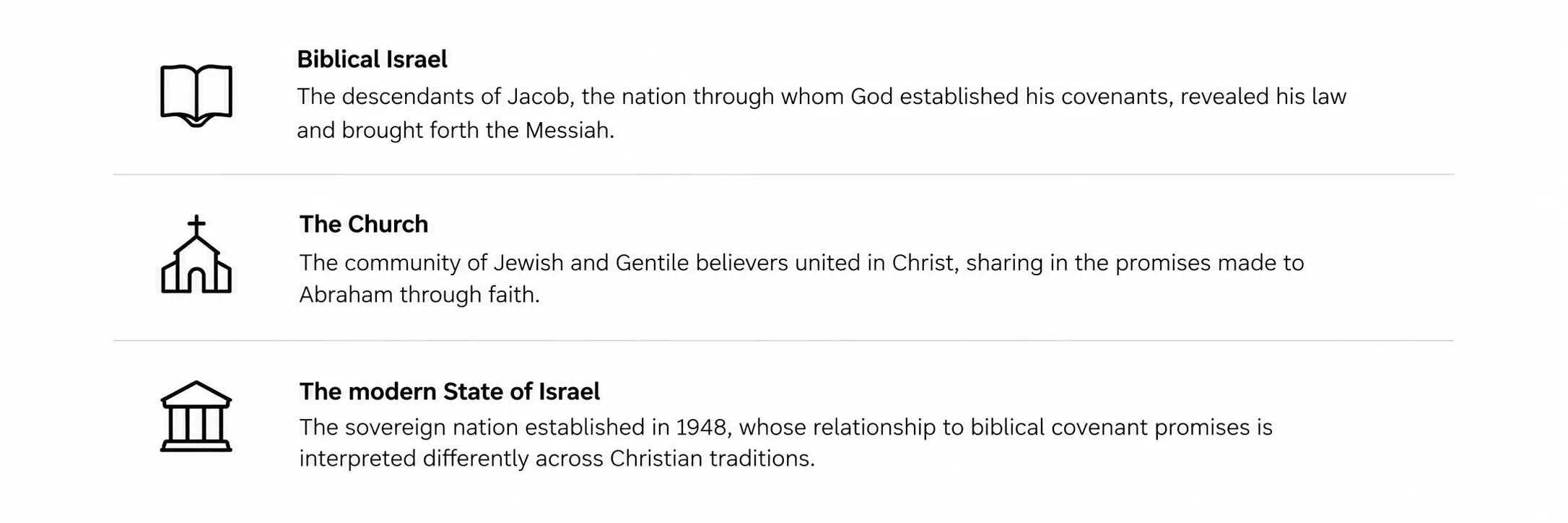
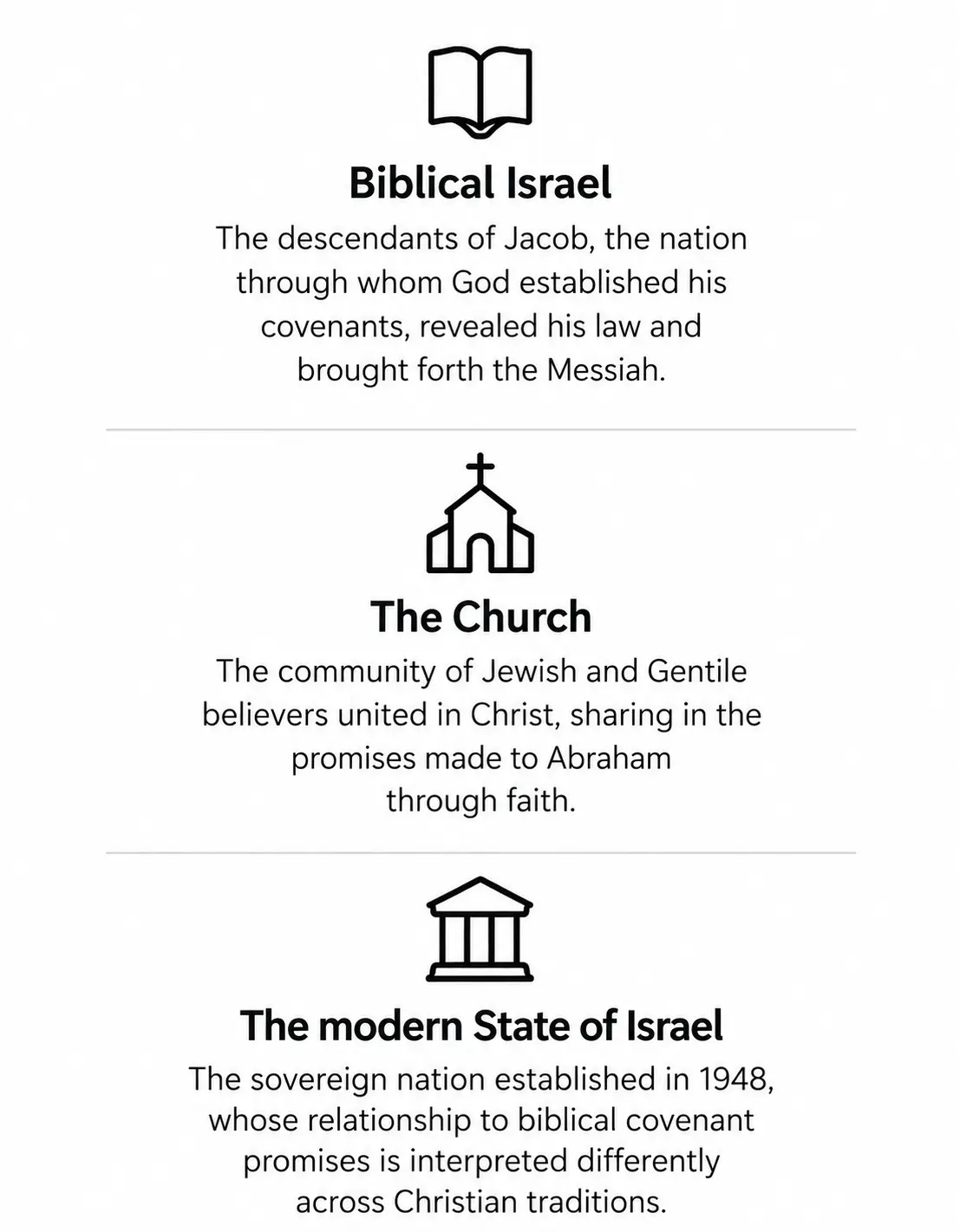
This is, broadly speaking, the theology of supersessionism, sometimes called replacement theology. It holds that the Church has superseded Israel as the people of God, inheriting the covenant promises once given to the Jewish people.
But this understanding fundamentally misunderstands the nature of God’s people, particularly the relationship between Israel and the Church. It assumes a transfer of covenant identity where Scripture describes something far more remarkable: the inclusion of the Gentiles in promises that were never theirs by ancestry (Ephesians 2:11–13, 19).
Paul’s illustration in Romans 11 is especially telling. Gentile believers aren’t depicted as a new tree planted in place of Israel, but as wild branches grafted into an existing olive tree. They share in its nourishing root, but they don’t replace it. Indeed, Paul explicitly warns the Gentiles against boasting over the natural branches.
“Do not be arrogant toward the branches. If you are, remember it is not you who support the root, but the root that supports you” (Romans 11:18).
The distinction matters. The inclusion of the Gentiles, while always in God’s plan, doesn’t then mean the erasure of Israel, nor does the unity of Jew and Gentile in Christ imply that God has somehow become unfaithful to the people through whom His promises were first revealed.
The nation of Israel holds a unique and foundational place in salvation history, which no other nation can claim. They were the people to whom God first spoke promises, gave signs and miracles, ordered through covenant and law, and through whom the world’s Saviour would come.
Paul himself makes this point in Romans 9:4–5, where he lists Israel’s privileges: the adoption, the glory, the covenants, the giving of the law, the worship, the promises and the patriarchs. And from their ancestry came Christ himself. Regardless of all else, we love them for their Saviour’s sake.
But their rejection of Jesus, the One through whom God’s promises are brought to fulfilment, was a source of profound grief for Paul. He describes his “great sorrow and unceasing anguish” for his fellow Israelites (Romans 9:2–3).
He wrestles with Israel’s standing before God and their rejection of the very Messiah God had sent. Yet he makes the point that God hadn’t rejected His people. On the contrary, God had remained faithful to everything he had promised. It was Israel, or more precisely, those among Israel who rejected Christ, who had turned away from Him. Paul asks directly, “Has God rejected His people?” and answers, “By no means!” (Romans 11:1).
Paul hoped that his own ministry to the Gentiles would provoke his fellow Jews to jealousy, leading some of them to salvation (Romans 11:13–14). Far from regarding Israel as a people whose place in God’s purposes had simply been forfeited, Paul continued to long for their reconciliation with God. Their unbelief grieved him, but it didn’t lead him to conclude that God’s covenant faithfulness had come to an end.
The Church doesn’t replace Israel. Rather, Gentile believers are welcomed into “the true Israel”, the people of God constituted not merely by physical descent but by faith in God’s promises. As Paul explains, “not all who are descended from Israel belong to Israel” (Romans 9:6). But their inclusion doesn’t erase ethnic Israel or bring God’s purposes for the Jewish people to an end.
Belonging to God’s covenant people is neither exclusively Jewish nor does it require the rejection or erasure of the very Jewish foundations upon which Christianity rests. The promises made to Abraham find their fulfilment in Christ, and through him, both Jew and Gentile become heirs of those promises. As Paul writes, “if you are Christ’s, then you are Abraham’s offspring, heirs according to promise” (Galatians 3:29).
The inclusion of one doesn’t necessitate the exclusion of the other, nor does the unity of God’s people render Israel’s history, identity, or place in God’s redemptive purposes irrelevant or finished.
What, Then, Of The Jewish Question Today?
All of this makes the Christian conscience towards Israel and the Jewish people somewhat more nuanced than it might be towards any other nation.
I don’t believe Christians are encouraged to overlook injustice or wrongdoing, wherever it occurs or whoever is responsible. As Micah 6:8 reminds us, God’s people are called to “do justice, and to love kindness, and to walk humbly” with Him. So I’m not suggesting that the modern State of Israel deserves an indiscriminate free pass or is entitled to special privileges simply because of a Christian understanding of covenantal promises. Biblical promises don’t automatically confer political or moral immunity on the modern state of Israel.
But neither can the world ignore its long and complicated history with the Jewish people, or the prejudices and evils to which they’ve been subjected over the centuries. Antisemitism has been a persistent and deeply uncomfortable presence throughout the catalogues of human history, and the Jewish people have endured extraordinary persecution, displacement and attempts at their destruction.
Yet I believe that through all of this, Paul’s words of lament and hope still ring true of the people he describes as “loved on account of the patriarchs” (Romans 11:28).
Israel has experienced a partial hardening of their hearts, which opened the way for Gentile inclusion, but Paul still envisages a time when “all Israel will be saved, when the Deliverer will come from Zion and turn ungodliness away from Jacob” (Romans 11:25–27). Indeed, the prophet Zechariah foretold a time when the inhabitants of Jerusalem “would look upon the one they had pierced and mourn for him as one mourns for an only child” (Zechariah 12:10).
While some suggest that this prophecy has already been fulfilled, others look to the words of Revelation 1:7, which speaks of Christ’s return, when “every eye will see him, even those who pierced him”, and see this as pointing towards a future fulfilment and turning of the Jewish people towards their Messiah.
These passages suggest that God’s purposes for ethnic Israel aren’t yet exhausted. The Jewish people remain a people whose history is steeped in covenant and promise, some of whom continue to await the Messiah, while others have long since abandoned religious belief altogether. And yet, whether religious or secular, observant or otherwise, their Jewish identity hasn’t disappeared. Nor can the world overlook the extraordinary history of a people who’ve survived centuries of exile, persecution and displacement.
The Christian response, then, can’t simply be one of political allegiance, nor should it be one of theological indifference. We’re called to recognise both the enduring significance of Israel in the biblical narrative and the dignity of Jewish people as human beings, without confusing either with an unconditional endorsement of the actions of a modern government. That distinction matters, particularly when the conversation moves from the pages of Scripture into the increasingly hostile arena of public discourse.
Israel, The Church, and the Christian Conscience
Perhaps this brings us back to Bonhoeffer, and to the question of the Christian conscience.
One of the earliest controversies confronting the German Protestant Church under Nazism was the adoption of the Aryan Paragraph. Racial restrictions that had been introduced into German civil law were now being imposed within parts of the Church itself, excluding Christians of Jewish ancestry from positions of ministry and leadership. Their baptism, their confession of Christ and their membership in the Christian community were no longer sufficient. Their Jewish ancestry had become grounds for exclusion.
Of all people in Germany, surely Christians should’ve known better. They worshipped a Jewish Messiah, read the Hebrew Scriptures, and professed faith in the God of Abraham, Isaac and Jacob. They’d read Paul’s declaration that in Christ there is “neither Jew nor Greek” (Galatians 3:28), and that Christ had broken down the dividing wall of hostility between Jew and Gentile (Ephesians 2:14–16). Yet parts of the Church had allowed the racial prejudices of the surrounding culture to determine who could belong and serve among them.
Bonhoeffer understood that this wasn’t simply a political question, but one that struck at the very nature of the Church. His immediate concern was the exclusion of Christians of Jewish ancestry from the Church on racial grounds, rather than the broader question of Israel’s continuing place in God’s redemptive purposes. But the two questions aren’t entirely unrelated. If the Church couldn’t disregard the Jewish ancestry of its own members without compromising its identity in Christ, surely it ought to be equally careful about disregarding the Jewish foundations of the faith itself.
And perhaps that’s the question we ought to leave with today. If God’s faithfulness to Israel hasn’t come to an end, and if the Church owes its very existence to promises first made to the Jewish people, shouldn’t that mean something for the Christian conscience?
Not that Israel should be beyond criticism, nor that Jewish people should be held to a different moral standard. But surely Christians, of all people, ought to be especially conscious of the history, prejudices and theological assumptions that shape the way we speak about them.
If the German Church should’ve known better, what responsibility does that place upon the Church today?
A note on AI: AI was used to assist with editing and refining this article. The arguments, theological position, and conclusions are my own.