
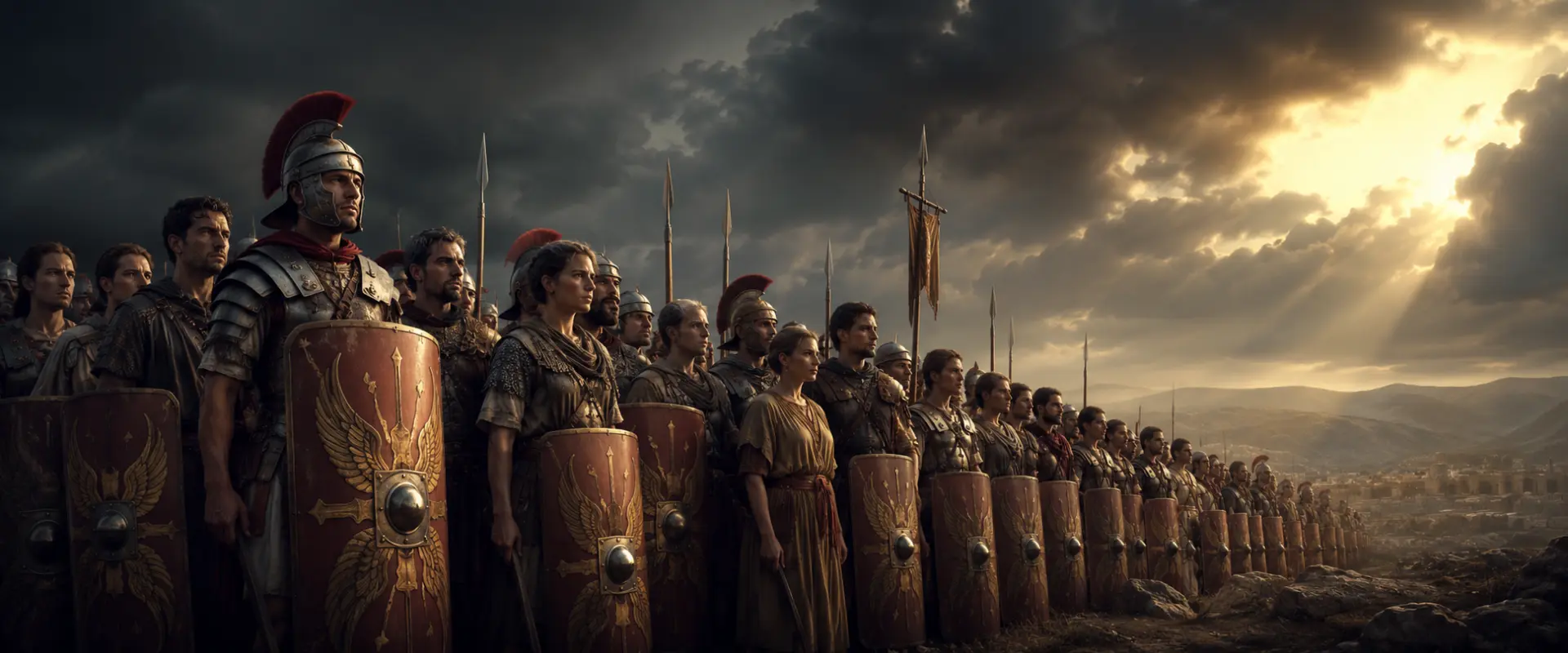
In short: Ephesians 5 isn’t just about husbands and wives. Paul’s word for submit is hupotassō, a Greek word with military overtones, meaning to arrange under, to take one’s place in proper alignment. Before he addresses marriage, he teaches the whole church to submit to one another out of reverence for Christ. Men and women are called to take their place together as warriors in formation beneath the victorious banner of Jesus.
The church is at war with the devil. That isn’t an overstatement. It’s the world of Ephesians.
From the opening chapter, Paul’s words draw our eyes above the visible world and to Christ enthroned over every ruler, authority, power, and dominion. In chapter 2, we’re reminded that we were once dead in sin, walking according to the ruler of the kingdom of the air. In chapter 3, Paul says the wisdom of God is now being displayed through the church to the rulers and authorities in the heavenly places. By the time we reach chapter 6, the veil is pulled back completely. We’re told to put on the whole armour of God and, in doing so, to stand against the schemes of the devil (Ephesians 6:11), the great enemy of the saints (Revelation 12:10-11, 13:7).
And, despite the life-and-death nature of the battle, believers can have confidence in both the armour and the One who provides it. The writer of Hebrews reminds us that the Son of God took on flesh and blood so that through death he might destroy the one who has the power of death, that is, the devil, and free those who were held in slavery by the fear of death (Hebrews 2:14).
This cosmic battle is laid out powerfully in Romans, the first and largest of Paul’s letters as they appear in our New Testament, and his most expansive theological treatment of the gospel. There, Paul doesn’t present sin and death as small individual struggles, but as enslaving powers from which humanity must be rescued. Yet Romans also gives believers deep confidence. Although we’re still engaged in the war, the outcome has already been won and is assured. In Christ, we’re more than conquerors (Romans 8:37).
This battle language matters because it shapes how we read the whole letter of Ephesians, including Ephesians 5, a chapter often (mis)understood to be primarily dealing with authority in marriage. But Paul isn’t writing to individuals, giving pastoral advice for their personal lives. He’s writing to the church, to the collective body of believers, gathered under Christ, who are called to stand together against a defeated but still raging enemy (1 Peter 5:8-9, James 4:7, 2 Corinthians 10:3-5).
In this article, I want to rediscover the lost warriors of Ephesians 5: the men and women who align themselves in formation against their common enemy, under the victorious banner of Christ.
Ephesians 5 Isn’t Just About Husbands And Wives
We often read Ephesians 5 as though Paul has suddenly forgotten about the battle. Like he’s abruptly wandered away from the great cosmic conflict that has occupied his mind for the last four chapters and decided to open a side discussion on domestic arrangements and first-century household codes.
However, to misread Ephesians 5 in this way is to overlook one of the most important directives in the letter: how and why believers are to be ordered under Christ and rightly ordered toward one another in their great spiritual battle. Paul is describing what a Spirit-filled, Christ-ruled, battle-ready people look like in the ordinary places of life, in marriage, in parenting, in work, in worship, and in the shared life of the church.
Look at the language he has already invoked. Rulers. Authorities. Powers. Darkness. Armour. Resistance. Conquest. Deliverance. These are the words that fill the world of Ephesians. And then, right in the middle of that battlefield, Paul says submit (Ephesians 5:21).
But not submit as we often hear it in English, meaning passive compliance or unquestioning deference. Hupotassō, a Greek word with military overtones, meaning to arrange under, to order under, to take one’s place in proper alignment, is his word of choice. This posture of ordering oneself in proper alignment for the battle is the imperative of every believer in their interdependent relationships toward one another.
It means the war isn’t merely “Christians versus temptations.” It’s the people of God together, ordered under Christ and rightly aligned with one another, standing in their collective battle against the ruler of the kingdom of the air. And this kind of ordering matters deeply in Christ-centred relationships. We’re called to have one another’s backs, stand ready to defend, and to follow Christ together into battle.
The Christian life has never been individualistic. It’s collective. When you’re saved, you’re brought into a family. You’re placed as a living stone in the house God is building. And you become part of a people enlisted in the great cosmic battle between Christ and the powers of darkness.
Doesn’t Ephesians Only Tell Wives To Submit To Husbands?
No.
Paul does speak directly to wives, and we don’t need to pretend otherwise. But he doesn’t speak only to wives, merely first to wives. Before he addresses marriage, he has addressed the whole church, teaching that they ought to “submit” (hupotassō) to one another “out of reverence for Christ.” Verse 21 gathers the whole church under Christ before Paul then applies that ordered life to particular relationships. Wives are addressed. Husbands are addressed. Both are brought under the Lordship of Jesus.
That matters because in verse 22, the verb “submit” isn’t repeated. It’s carried over from verse 21. Paul doesn’t introduce submission as a private command for wives. He applies the mutual ordering of the whole Christian community to marriage.
If submit meant “wives obey your husbands” in an authoritative sense, Paul had other words he could have used. If he wanted to say “obey,” he could have. That word is hupakouō, meaning to hear under, to heed, to obey a command or authority.
But that isn’t the word Paul uses for husbands and wives. Paul reaches back to the word already governing the whole Spirit-filled community: hupotassō. Ordered under. Arranged under. Properly aligned. Not passive disappearance or voiceless compliance. Not unquestioning deference but the willing ordering of oneself under Christ and towards another for the sake of love, holiness, and unity.
Paul then speaks secondly to husbands. Their call isn’t domination, control, or authority, but love. Not shallow or convenient love, but the sacrificial kind of love that led Christ to a dark and lonely garden and, finally, a painful death on a rough wooden cross.
Husbands are called to cruciform love. “Husbands, love your wives, as Christ loved the church and gave himself up for her.”
So yes, wives are called into ordered alignment out of reverence for Christ. And so are husbands. The husband submits by giving himself for his wife in Christlike love. The wife submits as one who belongs first to Christ. Both are ordered under the Lord. Both are called away from selfishness and both are summoned into the shared life of a Spirit-filled people being formed for battle.
And this matters because marriage is the only relationship that Paul says mirrors Christ and the church. Children and parents matter. Servants and masters matter. But marriage is given a particular weight because it points beyond itself. “This mystery is profound,” Paul says, “and I am saying that it refers to Christ and the church.”
That means Christian marriage isn’t merely a private arrangement between two people. It’s a living witness to the gospel. It’s meant to display something true about Christ’s self-giving love and the church’s faithful response. A husband doesn’t picture Christ by ruling over his wife, but by laying himself down for her. The wife doesn’t picture the church by disappearing beneath her husband, but by honouring and defending him in the faithful, Spirit-filled life they share together.
In other words, marriage becomes part of the battle. The devil loves accusation, fear, domination, resentment, selfishness, and disorder. But a marriage ordered under Christ tells a different story. It says that love is stronger than power. Sacrifice is greater than control. Unity isn’t weakness. And the household that belongs to Jesus isn’t a field left undefended for the enemy to scatter seed, but reclaimed kingdom territory where Christ’s victory is displayed.
The Lost Warriors Of Ephesians 5
Some of the force of Ephesians 5 has been lost in translation. Paul’s Greek word is hupotassō, from hupo, meaning under, and tassō, meaning to arrange or order and carries military tones. When the idea moved through Latin, especially through the Vulgate, the primary Bible of the Western church for over a thousand years, it was rendered with words like subiecti and subditae, carrying the sense of being subject or placed under. The military tones are largely absent from this translation. Then in English we inherited the word submit, from the Latin submittere, meaning to lower, yield, or place under. The meaning isn’t wrong, but the full picture has been flattened and rendered one-dimensional.
We now hear submit and think hierarchy, compliance, or one person beneath another. But in the battlefield world of Ephesians, the deeper meaning is ordered formation: believers arranged under Christ, aligned with one another, and ready to stand together against the enemy.
Ephesians is a window into an ancient story, a battle raging since Eden but already won in eternity. Further, this letter belongs within the great sweep of the biblical narrative: two kingdoms in conflict, humanity held captive, sin and death defeated, and the one true King, the glorious and resurrected Christ, reigning over all.
When reading Ephesians 6, it seems that believers have no real trouble encouraging men to step into their warrior calling, to stand firm, defend the vulnerable, resist evil, and take their place in the battle. But the story often plays out a little differently when it comes to women. We’re more comfortable calling men to courage than calling women to the same. But ladies, shrinking back isn’t part of the deal.
In Christ, women aren’t spiritual bystanders. They’re not merely lovely wall decorations in the household of God. And they’re not called to watch the battle from the safety of the sidelines while the men march forward. They’re clothed in the same armour, filled with the same Spirit, rescued by the same blood, and summoned under the same victorious Lord.
That doesn’t erase the goodness of marriage, motherhood, femininity, gentleness, or quiet faithfulness. But it does mean none of those things should ever be mistaken for weakness. A woman ordered under Christ isn’t a lesser soldier. She is a sister in the ranks, a co-heir of grace, a living stone in the house God is building, and a witness to the watching powers that Jesus reigns.
Anyone who tells you that it’s unbiblical for women to be warriors hasn’t read Ephesians properly. Paul doesn’t hand the armour of God to men alone. He writes to the church. Truth, righteousness, gospel readiness, faith, salvation, the word of God, and prayer belong to every believer who stands under Christ. Women aren’t excluded from the battle. They’re addressed, equipped, and summoned to stand.
So, women, let’s go to work.
If you’re a wife, arrange yourself in defence and formation with your husband, ordered together under Christ. If you’re single, widowed, divorced, young, old, raising children, serving quietly, teaching faithfully, praying in hidden places, building the church, or simply trying to stand firm in a world that wants you weak and distracted, take your place.
You’re not outside the battle. You’re not waiting for permission to be faithful. You’re not less necessary because your life doesn’t fit one particular domestic shape. In Christ, you’re clothed in the same armour, filled with the same Spirit, and summoned to stand with all the people of God against the schemes of the devil.
So don’t shrink back. Don’t confuse gentleness with passivity, or faithfulness with silence. Stand firm. Defend what is good. Strengthen the weary. Resist the enemy. Honour Christ. Love his people.
Men and women, take your place together as warriors in formation beneath the victorious banner of Jesus.