

All Things Made New: Jesus Leads The Way
“There is a day coming when the old will pass away. Every wrong will be right, no more darkness, no night. The Son will light the way.”
The entire Christian faith rests on this foundation: first and foremost, the resurrection of Jesus himself, and then the promised resurrection of those who belong to him. Paul calls Jesus “the firstfruits of those who have fallen asleep” (1 Corinthians 15:20), meaning his resurrection is the beginning and guarantee of what is to come for all who follow him. He goes before us so that we might share in his risen life.
It’s no overstatement to say that if the resurrection didn’t really happen, Christianity unravels.
No matter how profound Jesus’ teachings or how compassionate his miracles, without the resurrection, there’s no victory over death, no assurance that sin has been dealt with, and ultimately, no enduring hope. Without it, Christianity becomes merely a philosophy or moral framework, interesting, perhaps even inspiring, but ultimately powerless to transform or save.
Yet, as the Apostle Paul declares, Jesus truly did rise, and those who trust in Him will rise too. Death, then, is not the end.
But it does raise some honest questions: What happens in the meantime? What takes place in the space between death and resurrection? Is there life after death, and if so, where is it? What is it like? How long does it last?
“Life After Death”
As it turns out, the Bible doesn’t spend much time describing what we often call “life after death”. Instead, Scripture places far more emphasis on what might be called life after life after death: a renewed, embodied life that begins with resurrection.
Paul offers a hint in 2 Corinthians 5:8 when he writes, “To be away from the body is to be at home with the Lord.” But while some interpret this verse to mean that, upon death, a believer is welcomed into Christ’s presence while awaiting the resurrection, Paul’s words are first and foremost pastoral, offering assurance in the face of death, and, ultimately, affirm the broader biblical hope of being fully and completely united with Christ in the life to come.
He expands on this just a few verses earlier in 2 Corinthians 5:1–4, describing our earthly bodies as “tents”, temporary, vulnerable, and wearing out. In contrast, he speaks of a “building from God, an eternal house in heaven, not built by human hands.” And this is key: Paul makes it clear that our ultimate destiny is not to be unclothed (disembodied), but to be reclothed with resurrection bodies, “so that what is mortal may be swallowed up by life” (v.4). In this way, resurrection isn’t a reversal of death, but its complete undoing.
The ultimate hope, not just of Paul, but of all the apostolic writers, and indeed the entire sweep of the biblical narrative, is the renewal and restoration of all creation, including humanity, culminating in God dwelling fully and finally with his people.
There is remarkably little concern for mapping out the timeline or explaining what happens in the interim; their eyes are fixed firmly on the end of the story, where all things are made new.
What, Biblically Speaking Then, Is Resurrection?
The Bible contains several stories of people being brought back to life, but these moments, though extraordinary, aren’t to be mistaken for resurrection in its fullest, biblical sense. They’re acts of divine power, but not the fulfilment of the Christian hope.
Resurrection, in the biblical sense, isn’t simply about coming back to life. It’s being raised into a new, eternal, and glorified existence: life; abundant, full, never-ending, transformed life. Life after life after death.
Let’s unpack the difference by comparing the resurrection of Lazarus and the resurrection of Jesus:
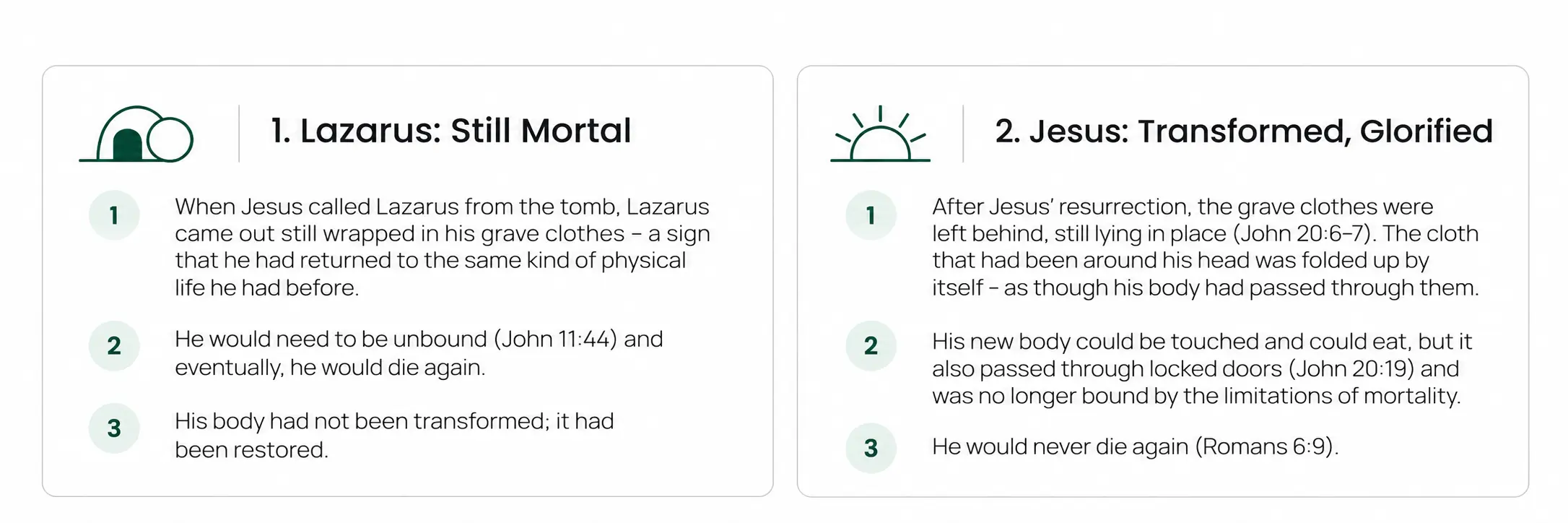
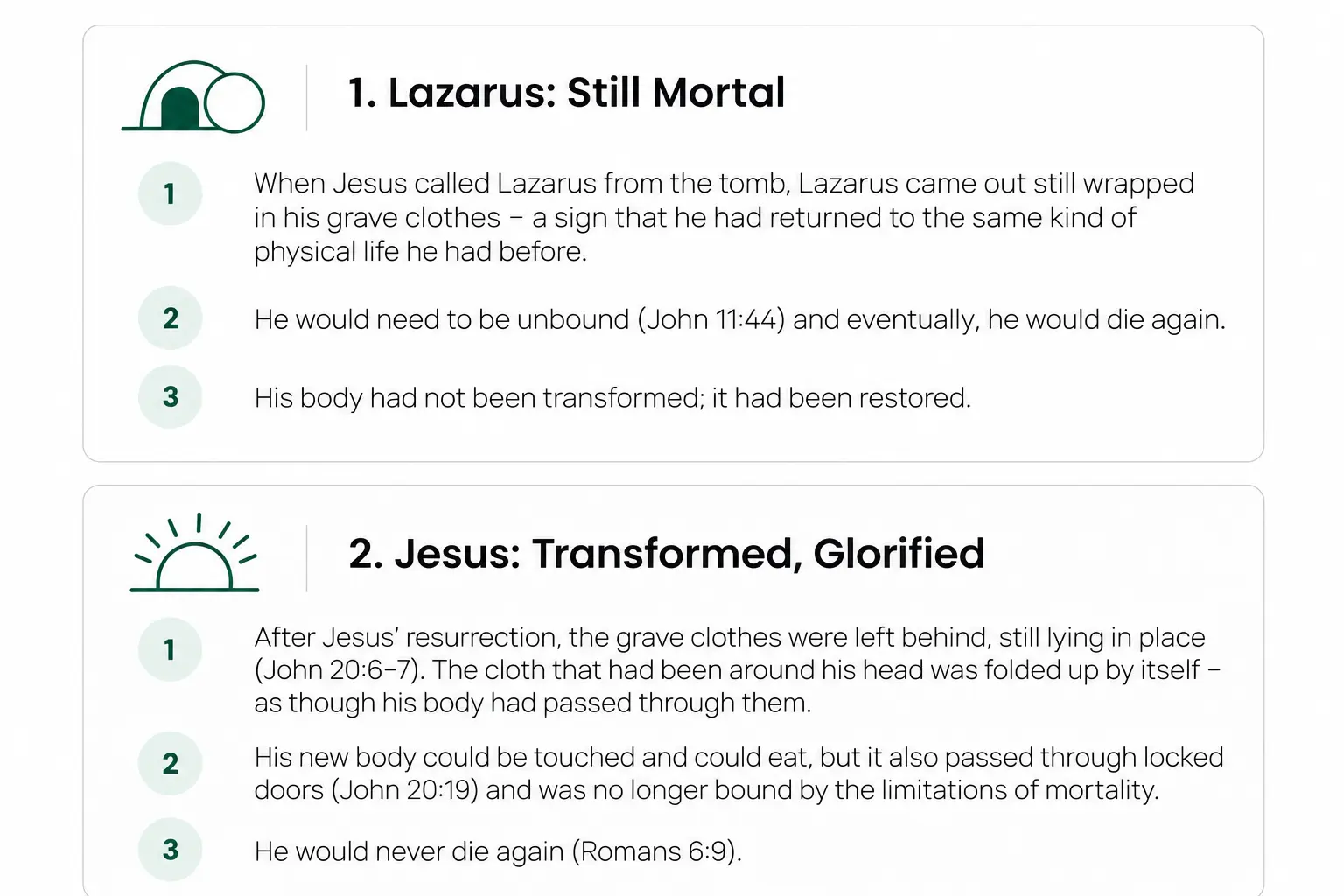
This contrast helps us understand the Christian hope more clearly. Resurrection, as shown in Jesus, isn’t just about returning from death but about stepping into a completely new, eternal kind of life. It’s a promise of transformation, not just restoration; a future where death no longer has the final say.
So Do We “Go To Heaven” When We Die?
Heaven is less of a specific location and more of a specific reality. It’s God’s space and God’s reality, the place where God’s presence is fully manifest. Heaven is often described as the throne of God, the seat of His rule, glory, and holiness, a real and eternal realm distinct from Earth.
Jesus often spoke about the Kingdom of Heaven. In the other Gospels, the same idea is expressed as “the Kingdom of God.” These terms are interchangeable; both describe God’s rule and reign.
Jesus taught that the Kingdom had already begun with His coming. He told His listeners, “The Kingdom of God is in your midst” (Luke 17:20–21). Yet, at the same time, He instructed His followers to pray, “Your kingdom come” (Matthew 6:10). This shows that the Kingdom is both present and future, already inaugurated, but not yet fully complete.
The Bible paints a beautiful picture of where this is heading. Heaven is God’s space. The Kingdom is God’s rule: heaven will one day come fully to earth (Revelation 21:1; Romans 8:21). The goal isn’t for us to go ‘up’ to heaven, but for heaven to come ‘down’ and fill the earth. It won’t be a vague, spiritual afterlife, but a renewed and restored creation where God dwells with His people, and where those who belong to Him live in resurrected, glorified bodies, forever.
“I Tell You Today, You Will Be With Me In Paradise”
A passage that’s often taken to be speaking about the temporary middle space, life after death, is Jesus’ words to the thief on the cross in Luke 23:43, who implored him to “remember me when you come into your Kingdom“. Jesus replied (as is translated in many English translations), “today, you will be with me in paradise”. However, when we take the Bible’s broader narrative seriously, one that places resurrection, not disembodied heaven, at the centre, I think a better reading of Luke 23 is “Truly I tell you today, you will be with me in paradise.”
With no punctuation in the original Greek, the phrase could be read either way, and I think the second reading seems a logical rendering of this verse, shifting the emphasis away from “today” being the moment of arrival, and instead placing it on the assurance of what’s to come.
Jesus’ words in Luke 23:43 are a beautiful declaration of salvation, not necessarily a detailed explanation of what happens after death. Further, they are words of assurance to a man facing impending death that this will not be the end. Jesus offers the promise of belonging, presence, and hope in the new creation, paradise (Revelation 2:7), where the tree of life is found, the final, eternal dwelling place of God with his people.
Yet whether we understand “paradise” as a temporary rest in God’s presence or a pointer to the resurrection to come, the heart of the promise is the same: you will be with me.
Our Hope Is in Christ
The gospel, the good news, doesn’t just tell us that we can be saved, but also what we’re saved from and what we’re saved to.
The gospel is that Jesus came to rescue us from the curse of sin and death. He lived, died, and rose again so that we could enter the Kingdom of Heaven, not because we earned it, but because He offers it freely to those who trust in Him. The New Testament speaks powerfully, and often, about the dramatic change that takes place when we come to know and believe in Jesus. It’s more than a change in beliefs or behaviour. It’s a transfer of identity and belonging.
Scripture describes it as moving from death to life, from the dominion of darkness into the kingdom of light, from being “children of wrath” (Ephesians 2:3) to becoming beloved children of God. This isn’t symbolic. It’s spiritual reality.
Paul puts it plainly: “You were dead in your sins… but God made you alive with Christ” (Colossians 2:13). Once disconnected from God, we’re now made alive, not by our own effort, but because of His mercy and love. The Spirit of God Himself comes to live in us (Romans 8:11), bringing new desires, new strength, and new life. Jesus called it being born again, a spiritual rebirth that starts the moment we believe. And He gave us this promise: “The one who believes in Me, even though they die, yet will they live” (John 11:25).
And this is where the promise comes full circle. The same Spirit who gives us life in Christ now is the Spirit through whom God promises to give life to our mortal bodies (Romans 8:11).
So no, we don’t go to “heaven” in the way we often imagine, floating in clouds, harps in hand, for all eternity. But what happens between death and resurrection? I don’t think Scripture gives us enough detail to answer that with certainty.
There are passages that suggest being with Christ after death, and others that look beyond death to resurrection and judgment. How these fit together, and what that experience might be like, isn’t entirely clear.*
What Scripture does make clear is that death is not the end of the story. Judgment awaits, Christ will return, the dead will be raised, and everything broken will be made new. For those who belong to Christ, the promise is not merely continued existence beyond the grave, but resurrection life in a renewed creation, where God dwells fully and finally with His people.
This is the unshakable hope of every believer: not simply life after death, but life after life after death with Jesus, and the restoration of all things.
A Final Note
If you’re reading this article (and thank you for being here!), and aren’t yet a believer and follower of Jesus, this raises something important. Something we all feel, whether we talk about it or not.
Mortality is our clue and our warning.
We were never meant to die. Deep down, we know this, which is why death feels so wrong, even when it’s expected. Our bodies ageing, our loved ones passing – these things all point to a world that’s not as it should be. Death is a signpost, reminding us that things are not yet made right.
But it’s also a warning. Life doesn’t go on forever, and the choices we make now matter. The gospel isn’t just about comfort after death; it’s a call to turn, to trust Jesus, and to step into his Kingdom life now. Because one day, the waiting will be over. The King will return. And heaven will come crashing in.
“What I am saying, dear brothers and sisters, is that our physical bodies cannot inherit the Kingdom of God. These dying bodies cannot inherit what will last forever. But let me reveal to you a wonderful secret. We will not all die, but we will all be transformed! It will happen in a moment, in the blink of an eye, when the last trumpet is blown. For when the trumpet sounds, those who have died will be raised to live forever.
And we who are living will also be transformed. For our dying bodies must be transformed into bodies that will never die; our mortal bodies must be transformed into immortal bodies. Then, when our dying bodies have been transformed into bodies that will never die, this Scripture will be fulfilled: “Death is swallowed up in victory. O death, where is your victory? O death, where is your sting?” | 1 Corinthians 15:50-55, NLT
* The Bible speaks about mind, body, soul, and spirit, but not always in the neat, Western categories we often use. Rather than dividing people into separate parts, Scripture generally presents human beings as integrated, embodied creatures. Our thoughts, actions, desires, relationships, and spiritual lives are all connected.
The Hebrew word *ruach* and the Greek *pneuma*, often translated as “spirit”, can refer to breath, wind, or spirit, depending on the context. In Ecclesiastes 12:7, the body returns to dust and the spirit returns to God who gave it. But what exactly does that mean for the person who has died? Is there continued consciousness, or does the person await resurrection without awareness of the passing of time?
I don’t think Scripture gives us enough information to answer that definitively.
My inclination is that we should be cautious about imagining a disembodied soul continuing independently of the body, as though our physical existence were merely temporary accommodation for our true selves. The biblical hope is the resurrection of the whole person, not simply the survival of some immaterial part of us.
Paul writes that our lives are now “hidden with Christ in God” and that when Christ appears, we will appear with Him in glory (Colossians 3:3–4). Whatever happens in the meantime, our future rests securely with Christ. Our hope isn’t in understanding precisely how we exist between death and resurrection, but in the promise that God will raise us to life.
Bible Passages To Explore: 1 Corinthians 15:20–22, Romans 6:5, Philippians 3:20–21, 2 Corinthians 5:1–4, 8, John 11:25–26, Colossians 3:3–4, Revelation 21:1–4, Romans 8:18–21, Ephesians 2:4–5, Colossians 2:13–14, John 5:24