

In my last article, I said there was no such thing as a bad Bible translation, with one exception: The Passion Translation. Which, frankly, isn’t really a translation at all and, when it comes down to it, isn’t even a very good paraphrase. On several counts, this solo project should never have made it onto the shelves of Christian bookstores or into the hands of believers, let alone be used from church pulpits for teaching and preaching, or recommended as a serious study Bible. And yet, that’s exactly what The Passion claims to be: a serious study Bible.
The Passion is problematic for several reasons. If you have anything else to choose from, and you do, you should choose that option instead and avoid this one entirely.
What Is The Passion?
The Passion is an interpretative rendering of the New Testament and selected Old Testament portions. The first portions were released in 2011, and the full Bible is projected to be completed in 2029.
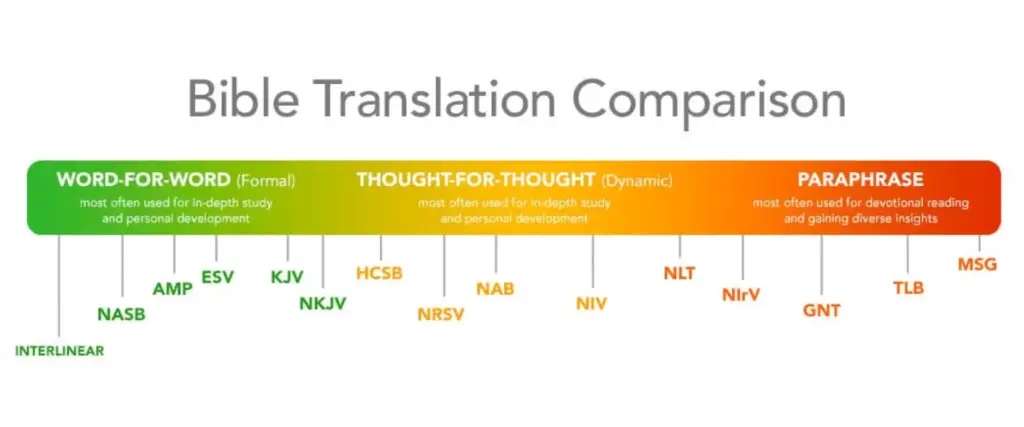
On the translation spectrum, which ranges from more literal approaches through to meaning-based translations, The Passion doesn’t merely sit at the far end. It falls off the map entirely. At best, it can only be described as a paraphrase. And even then, a very free one.
So What’s The Issue Exactly?
On its own website, it states: “The Passion Translation is an excellent translation you can use as your primary text to study God’s Word seriously…” with one reviewer even suggesting it rivals the work of the great Reformer Luther himself. Those are big shoes to fill. And that’s a very bold claim to make.
The Passion claims to be a serious study Bible, calling itself a translation, not a paraphrase, and placing itself alongside other established, credible translations. It claims to convey meaning directly from the original languages and to be suitable as a primary Bible.
If The Passion were marketed honestly as a devotional commentary, or even as a loose and imaginative retelling of Scripture, the criticism might be less severe. We might still think it’s theologically fluffy or emotionally overstated, but it wouldn’t be claiming the same kind of authority as a translation.
A devotional says, this how I reflect on the text. A translation says, this is what the text says. The issue is that The Passion consistently blurs that line, presenting like the latter while claiming the authority of the former. And that’s why the criticism is so strong, not because people dislike modern language (I’m all for updated, modern, understandable English translations), but because Scripture is being treated in a way Scripture itself doesn’t permit.
The First Major Problem: Special Revelation
The first major problem lies with the claims of its sole ‘translator’.
Brian Simmons is a former missionary who spent years working with indigenous communities, without doubt a noble and commendable endeavour. But missionary experience and spiritual sincerity are not the same thing as the scholarly rigour required for Bible translation.
Unlike mainstream translations, which are produced by large teams of linguists, historians, and theologians, The Passion is largely the work of one individual. That alone should raise caution. Scripture has always been safeguarded by community, accountability, and careful checks, not by solitary spiritual insight. Not only that, Brian Simmons doesn’t have recognised academic training or professional experience in ancient text criticism, manuscript analysis, or formal Bible translation as it is practised in mainstream scholarship. I’ll get to that shortly.
However, in relation to the work of ‘translating’, Brian Simmons also claims special revelation, saying the Passion is the result of a supernatural encounter with Jesus, who commissioned him, “breathed” on him, and promised to give him “secrets of the Hebrew language” and “other secrets of the Bible”. Angels were also involved, Brian claims, one specifically called Passion, for whom the project is named. In interviews, he frames his work on the Passion as a divine assignment, confirmed by the Lord.
The danger of special revelation isn’t just bad theology. It’s misplaced authority. It suggests that God has spoken again in a way that bypasses the apostolic witness and adds something new, something inaccessible to ordinary believers, something you only receive through a particular person. The ancient church had a word for movements built on special revelation and hidden knowledge reserved for the initiated; they called it Gnosticism. And it was recognised early on as a serious heresy.
I already talked about the canon of Scripture in my last article: the apostolic authority of the New Testament, and the verification of the Old Testament by Jesus himself. From the mid-fourth century, the church has agreed that the canon of Scripture is closed and there is no new revelation. So it really doesn’t matter what Brian Simmonds claims; The Passion is not a new or special revelation. God’s revelation in Christ is public, finished, and sufficient. It has been entrusted to the church through the apostles and preserved for us in Scripture.
No one gets secret keys. No one gets special downloads. No one gets to stand alongside the text and say, “This is what God really meant.” Brian Simmons’ claims of a divinely authorised, commissioned revelation that shaped his work are, quite frankly, not accepted within mainstream Christian tradition.
Collective Oversight And Accountability
The second issue is that this is primarily a solo effort, which I touched on above. Unlike other translations, and even paraphrases like The Message, this so-called translation wasn’t produced or reviewed by a broad, collaborative team. It wasn’t shaped through the normal layers of peer review and cross-checking that reputable Bible projects rely on.
Most established translations are worked on by committees of scholars drawn from across the denominational spectrum, precisely so that no one person’s theological preferences are baked into the text. The aim is accountability, balance, and careful restraint. When one individual, without recognised ancient text credentials, claims revelatory insight and produces a Bible text largely on their own, the issue isn’t personal character. It’s method and authority.
That’s why many scholars and pastors say The Passion Translation shouldn’t be treated as a translation at all (and certainly not promoted as a primary study Bible).
Okay, Well Maybe ‘Primary Study Bible’ Is Overstating Its Case…
But is it a good paraphrase? Nope, unfortunately, it’s not even that.
Translation is, in reality, partly interpretative, and the goal is meaning and clarity, not just word-for-word literality, as I discussed in my previous article. A paraphrase doesn’t claim to be a word-for-word translation; it tries to expand and explain meaning in everyday language. So there’s no problem, and most scholars would agree, with peer-reviewed, collaborative paraphrasing of Scripture, within the bounds and intent of the original language. A paraphrase can be useful for devotional-style or everyday reading, although not as a study or primary Bible.
Eugene Peterson, known for The Message paraphrase, never claimed The Message was a translation in a technical or scholarly sense, describing it as “a paraphrase designed to help people hear Scripture afresh in everyday language.” He intended it for reading, not study, and expected that it would sit alongside formal translations, not replace them. Although he worked from the original languages, he always stressed he was retelling the sense, not delivering the precise rendering of every word.
He also didn’t claim special revelation or divine commissioning, and his work was later reviewed and edited under the oversight of NavPress, with input from editors and biblical scholars. So while The Message wasn’t produced by a large translation committee, it was published within an accountable, institutional framework, with editorial and theological oversight. Eugene Peterson was honest about the category, the scholarship, and the intent of the Message, and this transparency is why many people (myself included) are comfortable using the Message within the scope it was intended, while still using more formal translations for study and teaching.
The same cannot be said for the Passion, which is fundamentally dishonest about its categorisation, its authority, and the kind of weight it asks readers to give it.
The Passion Imports A Specific Theological Vocabularly
Although Brian Simmons claims to have worked from the original languages, that claim is disputed by several critics, with many scholars arguing that the way he uses those languages doesn’t meet normal translation standards.
The Passion also doesn’t just use modern English; it regularly adds a particular kind of spiritual vocabulary often found in Word of Faith or New Apostolic Reformation circles. Language about power, spiritual impartation, heightened intimacy, activation, and breakthrough is sprinkled liberally throughout The Passion, often by expanding the biblical text itself rather than leaving those emphases to preaching.
When you compare The Passion with a standard translation like the ESV, the issue becomes obvious. This isn’t simply modern wording. It’s an expansion, based on a certain theological framework.
For example, Psalm 18:1 becomes “Lord, I passionately love you… you’ve become my Power!”, and another example, Galatians 2:19, inserts “heaven’s freedom”, wording that critics note isn’t indicated or even hinted at in the Greek.
The cumulative effect is a Bible text that starts to sound like charismatic devotional language. It’s not that the gospel isn’t vibrant – it totally is – but interpretive additions, with a specifically theological flavour, are being folded into Scripture itself, reworking it into a particular kind of telling. You can see a couple of examples set out below, for yourself:
Psalm 18:1 | English Standard Version
“I love you, O Lord, my strength.”
Psalm 18:1 | The Passion Translation
“Lord, I passionately love you! I want to embrace you, For now you’ve become my Power!”
Galatians 2:19 | English Standard Version
“For through the law I died to the law, so that I might live to God.”
Galatians 2:20 | The Passion Translation
“For through the law I died to the law so that I might live for God in heaven’s freedom.”
Galatians 2:20 | English Standard Version
“I have been crucified with Christ. It is no longer I who live, but Christ who lives in me. And the life I now live in the flesh I live by faith in the Son of God, who loved me and gave himself for me.”
Galatians 2:20 | The Passion Translation
“My old identity has been co-crucified with Christ and no longer lives; and now the essence of this new life is no longer mine, for the Anointed One lives his life through me. We live in union as one! My new life is empowered by the faith of the Son of God who loves me so much that he gave himself for me, dispensing his life into mine!”
Even if you agree with the theology in a broad sense (although, notice in the last example, The Passion shifts emphasis away from the believer’s faith toward Christ’s own faithfulness, without signalling that this is an interpretive choice), the issue is method. Those phrases are interpretive and devotional, and yet they are placed directly into the Bible text itself, claiming the authority of a primary study Bible rather than being confined to a footnote or commentary.
And this really is the difference between The Message and The Passion Translation. The Message is honest about what it is. It paraphrases openly, explains freely, and never pretends its wording is the text.
The Passion, by contrast, frequently embeds interpretation into the text (using specific theological vocabulary and without explanation) while presenting itself as Scripture, asking readers to receive devotional expansion as though it were the original words. It doesn’t just paraphrase, in ordinary terms, it adds material over and above what can reasonably be supported by the original text, expanding, reinterpreting and adding theological embellishments which are presented as Scripture itself.
That difference isn’t small. It’s the line between help and overreach, between interpretation offered and interpretation imposed, between a translation produced within the bounds of recognised scholarly frameworks and a text reshaped to reflect the ideology of a particular movement.
In 2022, The Passion Translation was removed from the BIble Gateway website, meaning it was no longer available for online reading or comparison alongside other major Bible translations. While Bible Gateway didn’t give a detailed explanation, the decision to remove The Passion translation is telling. It reflects wider concerns about how the work presents its authority, particularly its tendency to embed interpretation and theological expansion into the biblical text while claiming the status of a primary study translation.
Conclusion
In the end, the problem with The Passion Translation isn’t simply tone, language, or even broad theological emphasis (the reality is that some level of theological interpretation is unavoidable in any translation).
The problem is method and authority.
The Passion repeatedly expands the biblical text with interpretive and devotional language, resolves debated theological questions within the text itself (without giving any indication of the debate), and introduces concepts that are clearly not present in the original languages, all the while presenting itself as a faithful translation suitable for primary study.
It’s largely a solo project, lacking the collaborative scholarship, peer review, and cross-denominational accountability that safeguard responsible Bible translation. Its creator has framed the work in terms of divine commissioning and special insight – let’s be honest, that sounds a lot like a claim to apostolic authority, which further blurs the line between faithfully translating existing Scripture and adding to it on the basis of new or special revelation.
The Passion is not a reliable Bible for study, teaching, or forming conviction. It’s not even a very good paraphrase when other essential equivalent options are available. Christians, those seeking faith, or simply those who are curious, are far better served by translations that let Scripture speak for itself, clearly, faithfully, and without being rewritten through the lens of a particular movement.
To hear what many respected scholars have to say about The Passion, you can head here: The Passion Project – BibleThinker